## WIP: FastAPI Best Practices
Opinionated list of best practices and conventions we used at our startup.
For the last 1.5 years in production,
we have been making good and bad decisions that impacted our developer experience dramatically.
Some of them are worth sharing.
### Contents
1. [Project Structure. Consistent & predictable.](https://github.com/zhanymkanov/fastapi-best-practices#1-project-structure-consistent--predictable)
2. [Excessively use Pydantic for data validation.](https://github.com/zhanymkanov/fastapi-best-practices#2-excessively-use-pydantic-for-data-validation)
3. [Use dependencies for data validation vs DB.](https://github.com/zhanymkanov/fastapi-best-practices#3-use-dependencies-for-data-validation-vs-db)
4. [Chain dependencies.](https://github.com/zhanymkanov/fastapi-best-practices#4-chain-dependencies)
5. [Decouple & Reuse dependencies. Dependency calls are cached.](https://github.com/zhanymkanov/fastapi-best-practices#5-decouple--reuse-dependencies-dependency-calls-are-cached)
6. [Follow the REST.](https://github.com/zhanymkanov/fastapi-best-practices#6-follow-the-rest)
7. [Don't make your routes async, if you have only blocking I/O operations.](https://github.com/zhanymkanov/fastapi-best-practices#7-dont-make-your-routes-async-if-you-have-only-blocking-io-operations)
8. [Custom base model from day 0.](https://github.com/zhanymkanov/fastapi-best-practices#8-custom-base-model-from-day-0)
9. [Docs.](https://github.com/zhanymkanov/fastapi-best-practices#9-docs)
10. [Use Pydantic's BaseSettings for configs.](https://github.com/zhanymkanov/fastapi-best-practices#10-use-pydantics-basesettings-for-configs)
11. [SQLAlchemy: Set DB keys naming convention.](https://github.com/zhanymkanov/fastapi-best-practices#11-sqlalchemy-set-db-keys-naming-convention)
12. [Migrations. Alembic.](https://github.com/zhanymkanov/fastapi-best-practices#12-migrations-alembic)
13. [Set DB naming convention.](https://github.com/zhanymkanov/fastapi-best-practices#13-set-db-naming-convention)
14. [Set tests client async from day 0.](https://github.com/zhanymkanov/fastapi-best-practices#14-set-tests-client-async-from-day-0)
15. [BackgroundTasks > asyncio.create_task.](https://github.com/zhanymkanov/fastapi-best-practices#15-backgroundtasks--asynciocreate_task)
16. [Typing is important.](https://github.com/zhanymkanov/fastapi-best-practices#16-typing-is-important)
17. [Save files in chunk.](https://github.com/zhanymkanov/fastapi-best-practices#17-save-files-in-chunk)
18. [Be careful with dynamic pydantic fields.](https://github.com/zhanymkanov/fastapi-best-practices#18-be-careful-with-dynamic-pydantic-fields)
19. ~~SQL-first, Pydantic-second, Custom-third~~
20. [Validate url source (if users are able to upload files and send urls).](https://github.com/zhanymkanov/fastapi-best-practices#20-validate-url-source-if-users-are-able-to-upload-files-and-send-urls)
21. [root_validator to use multiple columns during validation.](https://github.com/zhanymkanov/fastapi-best-practices#21-root_validator-to-use-multiple-columns-during-validation)
22. ~~pre=True if data need to be pre-handled before validation~~
23. ~~raise a ValueError in pydantic, if schema faces http client~~
24. ~~remember fastapi response modeling~~
25. if must use sdk, but it's not async, use threadpools.
26. ~~use linters~~
### 1. Project Structure. Consistent & predictable
There are many ways to structure the project, but the best structure is a structure that is consistent, straightforward and has no surprises.
- If looking at the project structure doesn't give you an idea of what the project is about, then the structure might be unclear.
- If you have to open packages to understand what modules are located in it, then your structure is unclear.
- If the frequency and location of the files feels random, then your project structure is bad.
- If looking at the module's location and its name doesn't give you an idea of what's inside it, then your structure is very bad.
Although, the project structure, where we separate files by their type (e.g. api, crud, models, schemas)
presented by [@tiangolo](https://github.com/tiangolo) is good for microservices or projects with fewer scopes,
we couldn't fit it into our monolith with a lot of domains and modules.
Structure that I found more scalable and evolvable is inspired by Netflix's [Dispatch](https://github.com/Netflix/dispatch) with some little modifications.
```
fastapi-project
├── alembic/
├── src
│ ├── auth
│ │ ├── router.py
│ │ ├── schemas.py # pydantic models
│ │ ├── models.py # db models
│ │ ├── dependencies.py
│ │ ├── config.py # local configs
│ │ ├── constants.py
│ │ ├── exceptions.py
│ │ ├── service.py
│ │ └── utils.py
│ ├── aws
│ │ ├── client.py # client model for external service communication
│ │ ├── schemas.py
│ │ ├── config.py
│ │ ├── constants.py
│ │ ├── exceptions.py
│ │ └── utils.py
│ └── posts
│ │ ├── router.py
│ │ ├── schemas.py
│ │ ├── models.py
│ │ ├── dependencies.py
│ │ ├── constants.py
│ │ ├── exceptions.py
│ │ ├── service.py
│ │ └── utils.py
│ ├── config.py # global configs
│ ├── models.py # global models
│ ├── exceptions.py # global exceptions
│ ├── pagination.py # global module e.g. pagination
│ ├── database.py # db connection related stuff
│ └── main.py
├── tests/
│ ├── auth
│ ├── aws
│ └── posts
├── templates/
│ └── index.html
├── requirements
│ ├── base.txt
│ ├── dev.txt
│ └── prod.txt
├── .env
├── .gitignore
├── logging.ini
└── alembic.ini
```
1. Store all domain directories inside `src` folder
1. `src/` - highest level of an app, contains common models, configs, and constants, etc.
2. `src/main.py` - root of the project, which inits the FastAPI app
2. Each package has its own router, schemas, models, etc.
1. `router.py` - is a core of each module with all the endpoints
2. `schemas.py` - for pydantic models
3. `models.py` - for db models
4. `service.py` - module specific business logic
5. `dependencies.py` - router dependencies
6. `constants.py` - module specific constants and error codes
7. `config.py` - e.g. env vars
8. `utils.py` - non-business logic functions, e.g. response normalization, data enrichment, etc.
9. `exceptions` - module specific exceptions, e.g. `PostNotFound`, `InvalidUserData`
3. When package requires services or dependencies or constants from other packages - import them with explicit module name
```python
from src.auth import constants as auth_constants
from src.notifications import service as notification_service
from src.posts.constants import ErrorCode as PostsErrorCode # in case we have Standard ErrorCode in constants module of each package
```
### 2. Excessively use Pydantic for data validation
Pydantic has a rich set of features to validate and transform data.
In addition to regular features like required, non-required fields and default data,
it has built-in comprehensive data processing params like regex, enums for limited allowed options, length validation, email validation, etc.
```python3
from enum import Enum
from pydantic import AnyUrl, BaseModel, EmailStr, Field, constr
class MusicBand(str, Enum):
AEROSMITH = "AEROSMITH"
QUEEN = "QUEEN"
ACDC = "AC/DC"
class UserBase(BaseModel):
first_name: str = Field(min_length=1, max_length=128)
username: constr(regex="^[A-Za-z0-9-_]+$", to_lower=True, strip_whitespace=True)
email: EmailStr
age: int = Field(ge=18, default=None) # must be greater or equal to 18
favorite_band: MusicBand = None # only "AEROSMITH", "QUEEN", "AC/DC" values are allowed to be inputted
website: AnyUrl = None
```
### 3. Use dependencies for data validation vs DB
Pydantic can only validate the values of client input.
Use dependencies to validate data against database requirements like email already exists, user not found, etc.
```python3
# dependencies.py
async def valid_post_id(post_id: UUID4) -> Mapping:
post = await service.get_by_id(post_id)
if not post:
raise PostNotFound()
return post
# router.py
@router.get("/posts/{post_id}", response_model=PostResponse)
async def get_post_by_id(post: Mapping = Depends(valid_post_id)):
return post
@router.put("/posts/{post_id}", response_model=PostResponse)
async def update_post(
update_data: PostUpdate,
post: Mapping = Depends(valid_post_id),
):
updated_post: Mapping = await service.update(id=post["id"], data=update_data)
return updated_post
@router.get("/posts/{post_id}/reviews", response_model=list[ReviewsResponse])
async def get_post_reviews(post: Mapping = Depends(valid_post_id)):
post_reviews: list[Mapping] = await reviews_service.get_by_post_id(post["id"])
return post_reviews
```
If we didn't put data validation to dependency, we would have to add post_id validation
for every endpoint and write the same tests for each of them.
### 4. Chain dependencies
Dependencies can use other dependencies and avoid code repetition for similar logic.
```python3
# dependencies.py
from fastapi.security import OAuth2PasswordBearer
from jose import JWTError, jwt
async def valid_post_id(post_id: UUID4) -> Mapping:
post = await service.get_by_id(post_id)
if not post:
raise PostNotFound()
return post
async def parse_jwt_data(
token: str = Depends(OAuth2PasswordBearer(tokenUrl="/auth/token"))
) -> dict:
try:
payload = jwt.decode(token, "JWT_SECRET", algorithms=["HS256"])
except JWTError:
raise InvalidCredentials()
return {"user_id": payload["id"]}
async def valid_owned_post(
post: Mapping = Depends(valid_post_id),
token_data: dict = Depends(parse_jwt_data),
) -> Mapping:
if post["creator_id"] != token_data["user_id"]:
raise UserNotOwner()
return post
# router.py
@router.get("/users/{user_id}/posts/{post_id}", response_model=PostResponse)
async def get_user_post(post: Mapping = Depends(valid_owned_post)):
"""Get post that belong the user."""
return post
```
### 5. Decouple & Reuse dependencies. Dependency calls are cached.
Dependencies can be reused multiple times, and they won't be recalculated - FastAPI caches their result by default,
e.g. if we have a dependency which calls service `get_post_by_id`, we won't be visiting DB each time we call this dependency - only the first function call.
Knowing this, we can easily decouple dependencies onto multiple smaller functions that operate on a smaller scope and are easier to reuse in other routes.
For example, in the code below we are using `parse_jwt_data` three times:
1. `valid_owned_post`
2. `valid_active_creator`
3. `get_user_post`,
but `parse_jwt_data` is called only once, in the very first call.
```python3
# dependencies.py
from fastapi import BackgroundTasks
from fastapi.security import OAuth2PasswordBearer
from jose import JWTError, jwt
async def valid_post_id(post_id: UUID4) -> Mapping:
post = await service.get_by_id(post_id)
if not post:
raise PostNotFound()
return post
async def parse_jwt_data(
token: str = Depends(OAuth2PasswordBearer(tokenUrl="/auth/token"))
) -> dict:
try:
payload = jwt.decode(token, "JWT_SECRET", algorithms=["HS256"])
except JWTError:
raise InvalidCredentials()
return {"user_id": payload["id"]}
async def valid_owned_post(
post: Mapping = Depends(valid_post_id),
token_data: dict = Depends(parse_jwt_data),
) -> Mapping:
if post["creator_id"] != token_data["user_id"]:
raise UserNotOwner()
return post
async def valid_active_creator(
token_data: dict = Depends(parse_jwt_data),
):
user = await users_service.get_by_id(token_data["user_id"])
if not user["is_active"]:
raise UserIsBanned()
if not user["is_creator"]:
raise UserNotCreator()
return user
# router.py
@router.get("/users/{user_id}/posts/{post_id}", response_model=PostResponse)
async def get_user_post(
worker: BackgroundTasks,
post: Mapping = Depends(valid_owned_post),
user: Mapping = Depends(valid_active_creator),
):
"""Get post that belong the active user."""
worker.add_task(notifications_service.send_email, user["id"])
return post
```
### 6. Follow the REST
Developing RESTful API makes it easier to reuse dependencies in routes like these:
1. `GET /courses/:course_id`
2. `GET /courses/:course_id/chapters/:chapter_id/lessons`
3. `GET /chapters/:chapter_id`
The only caveat is to use the same variable names in the path:
- If you have two endpoints `GET /profiles/:profile_id` and `GET /creators/:creator_id`
that both validate whether the given profile_id exists, but `GET /creators/:creator_id`
also checks if the profile is creator, then it's better to rename `creator_id` path variable to `profile_id` and chain those two dependencies.
```python3
# src.profiles.dependencies
async def valid_profile_id(profile_id: UUID4) -> Mapping:
profile = await service.get_by_id(post_id)
if not profile:
raise ProfileNotFound()
return profile
# src.creators.dependencies
async def valid_creator_id(profile: Mapping = Depends(valid_profile_id)) -> Mapping:
if not profile["is_creator"]:
raise ProfileNotCreator()
return profile
# src.profiles.router.py
@router.get("/profiles/{profile_id}", response_model=ProfileResponse)
async def get_user_profile_by_id(profile: Mapping = Depends(valid_profile_id)):
"""Get profile by id."""
return profile
# src.creators.router.py
@router.get("/creators/{profile_id}", response_model=ProfileResponse)
async def get_user_profile_by_id(
creator_profile: Mapping = Depends(valid_creator_id)
):
"""Get profile by id."""
return creator_profile
```
Use /me endpoints for users own resources (e.g. `GET /profiles/me`, `GET /users/me/posts`)
1. No need to validate that user id exists - it's already checked via auth method
2. No need to check whether the user id belongs to the requester
### 7. Don't make your routes async, if you have only blocking I/O operations
Under the hood, FastAPI can [effectively handle](https://fastapi.tiangolo.com/async/#path-operation-functions) both async and sync I/O operations.
- FastAPI runs `sync` routes in the [threadpool](https://en.wikipedia.org/wiki/Thread_pool)
and blocking I/O operations won't stop [event loop](https://docs.python.org/3/library/asyncio-eventloop.html)
from executing the tasks.
- Otherwise, if the route is defined as `async` then it's called regularly via `await`
and FastAPI trusts you to do only non-blocking I/O operations.
The caveat is if you fail that trust and execute blocking operations within async routes,
event loop will not be able to run the next tasks until that blocking operation is done.
```python
import asyncio
import time
@router.get("/terrible-ping")
async def terrible_catastrophic_ping():
time.sleep(10) # I/O blocking operation for 10 seconds
pong = service.get_pong() # I/O blocking operation to get pong from DB
return {"pong": pong}
@router.get("/good-ping")
def good_ping():
time.sleep(10) # I/O blocking operation for 10 seconds, but in another thread
pong = service.get_pong() # I/O blocking operation to get pong from DB, but in another thread
return {"pong": pong}
@router.get("/perfect-ping")
async def perfect_ping():
await asyncio.sleep(10) # non I/O blocking operation
pong = await service.async_get_pong() # non I/O blocking db call
return {"pong": pong}
```
**What happens when we call:**
1. `GET /terrible-ping`
1. FastAPI server receives a request and starts handling it
2. Server's event loop and all the tasks in the queue will be waiting until `time.sleep()` is finished
1. Server thinks `time.sleep()` is not an I/O task, so it waits until it is finished
2. Server won't accept any new requests while waiting
3. Then, event loop and all the tasks in the queue will be waiting until `service.get_pong` is finished
1. Server thinks `service.get_pong()` is not an I/O task, so it waits until it is finished
2. Server won't accept any new requests while waiting
4. Server returns the response.
1. After a response, server starts accepting new requests
2. `GET /good-ping`
1. FastAPI server receives a request and starts handling it
2. FastAPI sends the whole route `good_ping` to the threadpool, where a worker thread will run the function
3. While `good_ping` is being executed, event loop selects next tasks from the queue and works on them (e.g. accept new request, call db)
- Independently of main thread (i.e. our FastAPI app),
worker thread will be waiting for `time.sleep` to finish and then for `service.get_pong` to finish
4. When `good_ping` finishes its work, server returns a response to the client
3. `GET /perfect-ping`
1. FastAPI server receives a request and starts handling it
2. FastAPI awaits `asyncio.sleep(10)`
3. Event loop selects next tasks from the queue and works on them (e.g. accept new request, call db)
4. When `asyncio.sleep(10)` is done, servers goes to the next lines and awaits `service.async_get_pong`
5. Event loop selects next tasks from the queue and works on them (e.g. accept new request, call db)
6. When `service.async_get_pong` is done, server returns a response to the client
The caveat is that operations that are non-blocking awaitables or sent to thread pool must be I/O intensive tasks (e.g. open file, db call, external API call).
- Awaiting CPU intensive tasks (e.g. heavy calculations, data processing, video transcoding) is worthless, since CPU has to work to finish the tasks,
while I/O operations are external and server does nothing while waiting for that operations to finish, thus it can go to the next tasks.
- Running CPU intensive tasks in other threads also isn't effective, because of [GIL](https://realpython.com/python-gil/).
In short, GIL allows only one thread to work at a time, which makes it useless for CPU tasks.
- If you want to optimize CPU intensive tasks you should send them to workers in another process.
**Related StackOverflow questions of confused users**
1. https://stackoverflow.com/questions/62976648/architecture-flask-vs-fastapi/70309597#70309597
- Here you can also check [my answer](https://stackoverflow.com/a/70309597/6927498)
2. https://stackoverflow.com/questions/65342833/fastapi-uploadfile-is-slow-compared-to-flask
3. https://stackoverflow.com/questions/71516140/fastapi-runs-api-calls-in-serial-instead-of-parallel-fashion
### 8. Custom base model from day 0.
Having a controllable global pydantic base model allows us to customize all the models within the app.
For example, we could have a standard datetime format or add a super method for all subclasses of the base model.
```python
from datetime import datetime
from zoneinfo import ZoneInfo
import orjson
from fastapi.encoders import jsonable_encoder
from pydantic import BaseModel, root_validator
def orjson_dumps(v, *, default):
# orjson.dumps returns bytes, to match standard json.dumps we need to decode
return orjson.dumps(v, default=default).decode()
def convert_datetime_to_gmt(dt: datetime) -> str:
if not dt.tzinfo:
dt = dt.replace(tzinfo=ZoneInfo("UTC"))
return dt.strftime("%Y-%m-%dT%H:%M:%S%z")
class ORJSONModel(BaseModel):
class Config:
json_loads = orjson.loads
json_dumps = orjson_dumps
json_encoders = {datetime: convert_datetime_to_gmt} # method for customer JSON encoding of datetime fields
@root_validator()
def set_null_microseconds(cls, data: dict) -> dict:
"""Drops microseconds in all the datetime field values."""
datetime_fields = {
k: v.replace(microsecond=0)
for k, v in data.items()
if isinstance(k, datetime)
}
return {**data, **datetime_fields}
def serializable_dict(self, **kwargs):
"""Return a dict which contains only serializable fields."""
default_dict = super().dict(**kwargs)
return jsonable_encoder(default_dict)
```
In the example above we have decided to make a global base model which:
- uses [orjson](https://github.com/ijl/orjson) to serialize data
- drops microseconds to 0 in all date formats
- serializes all datetime fields to standard format with explicit timezone
### 9. Docs
1. Unless your API is public, hide docs by default. Show it explicitly on the selected envs only.
```python
from fastapi import FastAPI
from starlette.config import Config
config = Config(".env") # parse .env file for env variables
ENVIRONMENT = config("ENVIRONMENT") # get current env name
SHOW_DOCS_ENVIRONMENT = ("local", "staging") # explicit list of allowed envs
app_configs = {"title": "My Cool API"}
if ENVIRONMENT not in SHOW_DOCS_ENVIRONMENT:
app_configs["openapi_url"] = None # set url for docs as null
app = FastAPI(**app_configs)
```
2. Help FastAPI to generate an easy-to-understand docs
1. Set `response_model`, `status_code`, `description`, etc.
2. If models and statuses vary, use `responses` route attribute to add docs for different responses
```python
from fastapi import APIRouter, status
router = APIRouter()
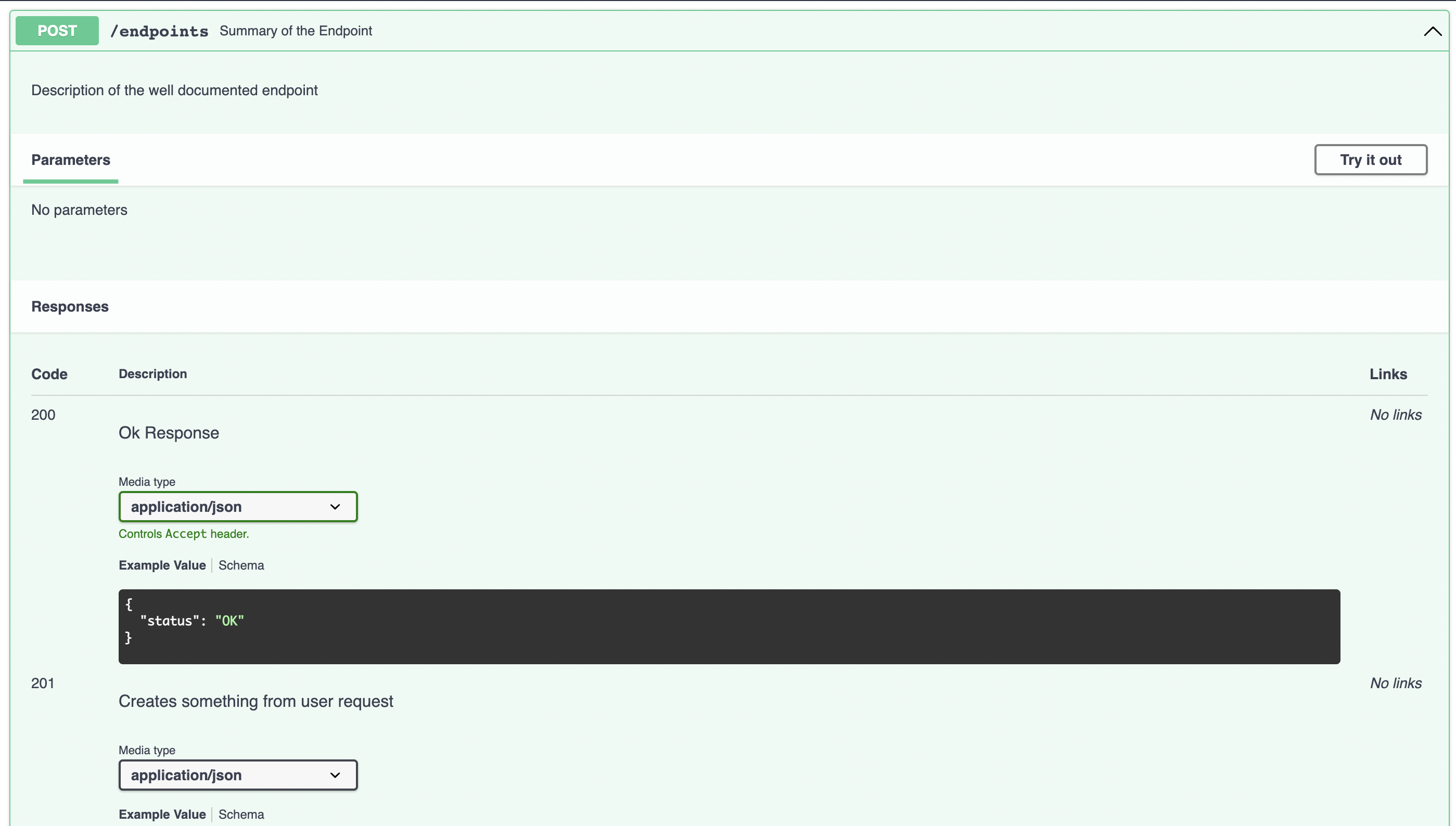
@router.post(
"/endpoints",
response_model=DefaultResponseModel, # default response pydantic model
status_code=status.HTTP_201_CREATED, # default status code
description="Description of the well documented endpoint",
tags=["Endpoint Category"],
summary="Summary of the Endpoint",
responses={
status.HTTP_200_OK: {
"model": OkResponse, # custom pydantic model for 200 response
"description": "Ok Response",
},
status.HTTP_201_CREATED: {
"model": CreatedResponse, # custom pydantic model for 201 response
"description": "Creates something from user request ",
},
status.HTTP_202_ACCEPTED: {
"model": AcceptedResponse, # custom pydantic model for 202 response
"description": "Accepts request and handles it later",
},
},
)
async def documented_route():
pass
```
Will generate docs like this:
### 10. Use Pydantic's BaseSettings for configs
Pydantic gives a [powerful tool](https://pydantic-docs.helpmanual.io/usage/settings/) to parse environment variables and process them with its validators.
```python
from pydantic import AnyUrl, BaseSettings, PostgresDsn
class AppSettings(BaseSettings):
class Config:
env_file = ".env"
env_file_encoding = "utf-8"
env_prefix = "app_"
DATABASE_URL: PostgresDsn
IS_GOOD_ENV: bool = True
ALLOWED_CORS_ORIGINS: set[AnyUrl]
```
### 11. SQLAlchemy: Set DB keys naming convention
Explicitly setting the indexes' namings according to your database's convention is preferable over sqlalchemy's.
```python
from sqlalchemy import MetaData
POSTGRES_INDEXES_NAMING_CONVENTION = {
"ix": "%(column_0_label)s_idx",
"uq": "%(table_name)s_%(column_0_name)s_key",
"ck": "%(table_name)s_%(constraint_name)s_check",
"fk": "%(table_name)s_%(column_0_name)s_fkey",
"pk": "%(table_name)s_pkey",
}
metadata = MetaData(naming_convention=POSTGRES_INDEXES_NAMING_CONVENTION)
```
### 12. Migrations. Alembic.
1. Migrations must be static and revertable.
If your migrations depend on dynamically generated data,
make sure the only thing that is dynamic there is the data itself, not its structure.
2. Generate migrations with descriptive names & slugs. Slug is required and should explain the changes.
Set human-readable file template for new migrations.
We use `*date*_*slug*.py` pattern, e.g. `2022-08-24_post_content_idx.py`
```
# alembic.ini
file_template = %%(year)d-%%(month).2d-%%(day).2d_%%(slug)s
```
### 13. Set DB naming convention
Being consistent with names is important. Some rules we followed:
1. lower_case_snake
2. singular form (e.g. `post`, `post_like`, `user_playlist`)
3. group similar tables with module prefix, e.g. `payment_account`, `payment_bill`, `post`, `post_like`
4. stay consistent across tables, but concrete namings are ok, e.g.
1. use `profile_id` in all tables, but if some of them need only profiles that are creators, use `creator_id`
2. use `post_id` for all abstract tables like `post_like`, `post_view`, but use concrete naming in relevant modules like `course_id` in `chapters.course_id`
5. `_at` suffix for datetime
6. `_date` suffix for date
### 14. Set tests client async from day 0
Writing integration tests with DB will most likely lead to messed up event loop errors in the future.
Set the async test client immediately, e.g. [async_asgi_testclient](https://github.com/vinissimus/async-asgi-testclient) or [httpx](https://github.com/encode/starlette/issues/652)
```python
import pytest
from async_asgi_testclient import TestClient
from src.main import app # inited FastAPI app
@pytest.fixture
async def client():
host, port = "127.0.0.1", "5555"
scope = {"client": (host, port)}
async with TestClient(
app, scope=scope, headers={"X-User-Fingerprint": "Test"}
) as client:
yield client
@pytest.mark.asyncio
async def test_create_post(client: TestClient):
resp = await client.post("/posts")
assert resp.status_code == 201
```
Unless you have sync db connections (excuse me?) or aren't planning to write integration tests.
### 15. BackgroundTasks > asyncio.create_task
BackgroundTasks can [effectively run](https://github.com/encode/starlette/blob/31164e346b9bd1ce17d968e1301c3bb2c23bb418/starlette/background.py#L25)
both blocking and non-blocking I/O operations the same way it handles routes (`sync` functions are run in a threadpool, while `async` ones are awaited later)
- Don't lie to the worker and don't mark blocking I/O operations as `async`
- Don't use it for heavy CPU intensive tasks.
```python
from fastapi import BackgroundTasks
from pydantic import UUID4
from src.notifications import service as notifications_service
# router.py
@router.post("/users/{user_id}/email")
async def send_user_email(worker: BackgroundTasks, user_id: UUID4):
"""Send email to user"""
worker.add_task(notifications_service.send_email, user_id) # send email after responding client
return {"status": "ok"}
```
### 16. Typing is important
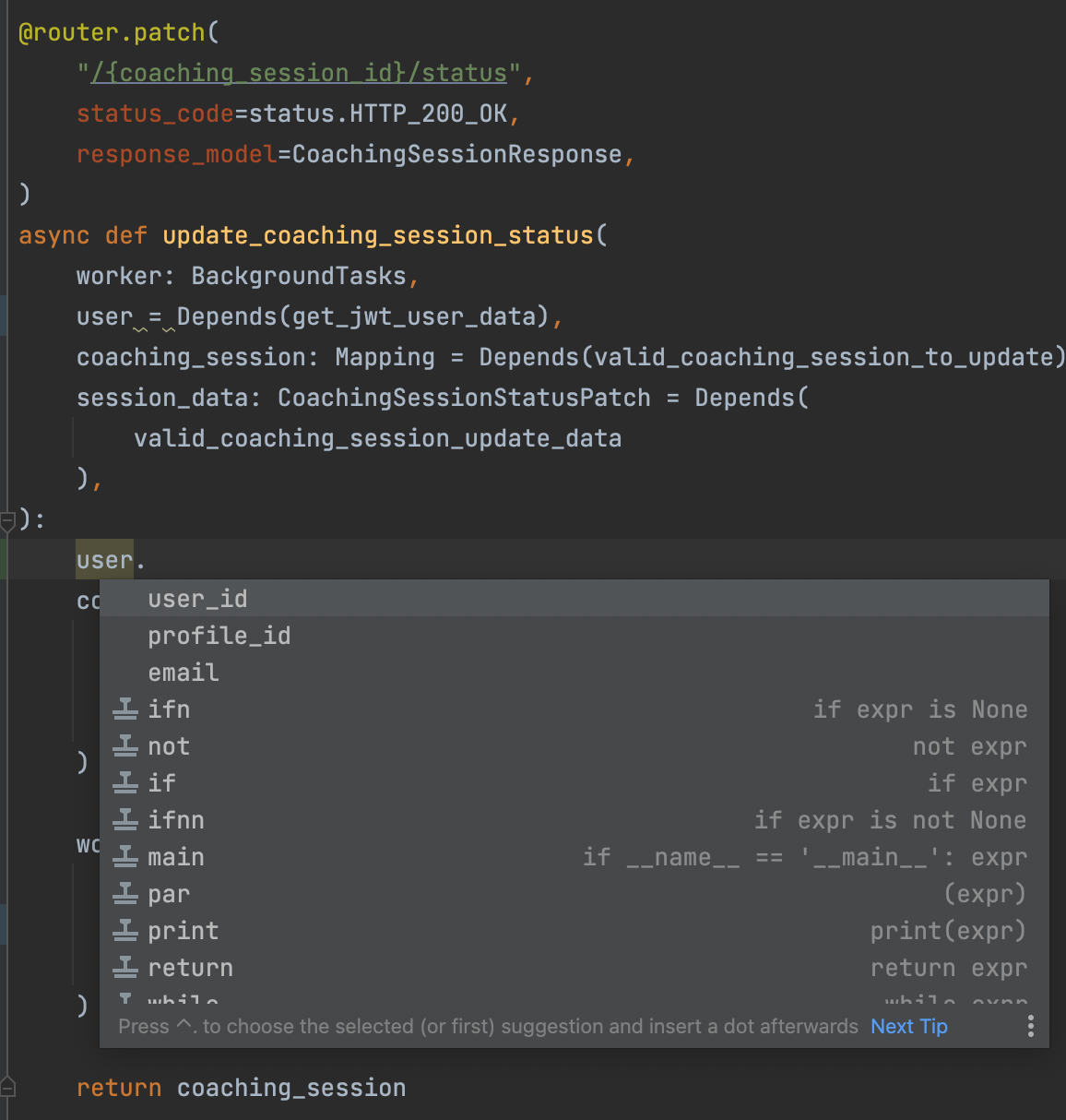
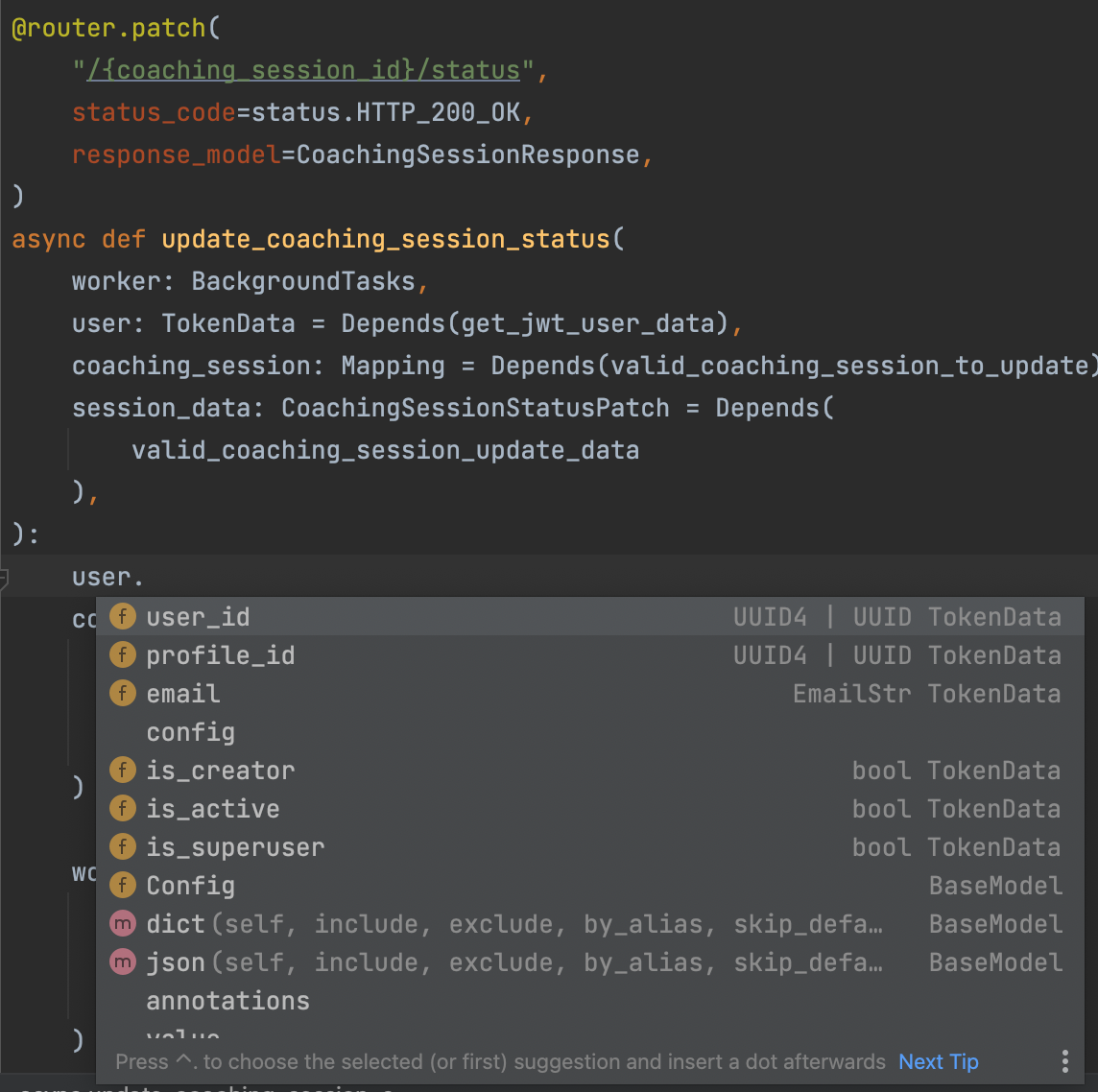
FastAPI, Pydantic, and modern IDEs encourage to take use of type hints.
**Without Type Hints**
 **With Type Hints**
 ### 17. Save files in chunk.
Don't hope your clients will send small files.
```python
import aiofiles
from fastapi import UploadFile
DEFAULT_CHUNK_SIZE = 1024 * 1024 * 50 # 50 megabytes
async def save_video(video_file: UploadFile):
async with aiofiles.open("/file/path/name.mp4", "wb") as f:
while chunk := await video_file.read(DEFAULT_CHUNK_SIZE):
await f.write(chunk)
```
### 18. Be careful with dynamic pydantic fields
If you have a pydantic field that can accept a union of types, be sure validator explicitly knows the difference between those types.
```python
from pydantic import BaseModel
class Article(BaseModel):
text: str | None
extra: str | None
class Video(BaseModel):
video_id: int
text: str | None
extra: str | None
class Post(BaseModel):
content: Article | Video
post = Post(content={"video_id": 1, "text": "text"})
print(type(post.content))
# OUTPUT: Article
# Article is very inclusive and all fields are optional, allowing any dict to become valid
```
**Not Terrible Solutions:**
1. Order field types properly: from the most strict ones to loose ones.
```python
class Post(BaseModel):
content: Video | Article
```
2. Validate input has only valid fields
```python
from pydantic import BaseModel, root_validator
class Article(BaseModel):
text: str | None
extra: str | None
@root_validator(pre=True) # validate all values before pydantic
def has_only_article_fields(cls, data: dict):
"""Silly and ugly solution to validate data has only article fields."""
fields = set(data.keys())
if fields != {"text", "extra"}:
raise ValueError("invalid fields")
return data
class Video(BaseModel):
video_id: int
text: str | None
extra: str | None
@root_validator(pre=True)
def has_only_video_fields(cls, data: dict):
"""Silly and ugly solution to validate data has only video fields."""
fields = set(data.keys())
if fields != {"text", "extra", "video_id"}:
raise ValueError("invalid fields")
return data
class Post(BaseModel):
content: Article | Video
```
3. Use Pydantic's Smart Union (>v1.9) if fields are simple
It's a good solution if the fields are simple like `int` or `bool`,
but it doesn't work for complex fields like classes.
```python
from pydantic import BaseModel
class Post(BaseModel):
field_1: bool | int
field_2: int | str
content: Article | Video
p = Post(field_1=1, field_2="1", content={"video_id": 1})
print(p.field_1)
# OUTPUT: True
print(type(p.field_2))
# OUTPUT: int
print(type(p.content))
# OUTPUT: Article
class Post(BaseModel):
field_1: bool | int
field_2: int | str
content: Article | Video
class Config:
smart_union = True
p = Post(field_1=1, field_2="1", content={"video_id": 1})
print(p.field_1)
# OUTPUT: 1
print(type(p.field_2))
# OUTPUT: str
print(type(p.content))
# OUTPUT: Article
```
### 19. SQL-first, Pydantic-second, Custom-last
### 20. Validate url source (if users are able to upload files and send urls)
Bad users could send strange urls for user facing public objects.
```python
from pydantic import AnyUrl, BaseModel
ALLOWED_MEDIA_URLS = {"mysite.com", "mysite.org"}
class CompanyMediaUrl(AnyUrl):
@classmethod
def validate_host(cls, parts: dict) -> tuple[str, str | None, str, bool]:
host, tld, host_type, rebuild = super().validate_host(parts)
if host not in ALLOWED_MEDIA_URLS:
raise ValueError(
"Forbidden host url. Upload files only to internal services."
)
return host, tld, host_type, rebuild
class Post(BaseModel):
thumbnail_url: CompanyMediaUrl
```
### 21. root_validator to use multiple columns during validation
```python
from pydantic import BaseModel, root_validator
class Profile(BaseModel):
username: str | None
first_name: str
last_name: str
@root_validator()
def set_username(cls, data: dict) -> dict:
if not data.get("username"):
data["username"] = f'{data["first_name"]}_{data["last_name"]}'
return data
```
### 22. pre if data need to be pre-handled before validation
### 23. you can just raise a ValueError in pydantic schemas, if schemas face http client
it wil return a detailed response of the failed fields
### 24. don't forget that fastapi converts response Model to Dict then to Model then to JSON
it may lead to bugs like model can parse only raw data (e.g. forced data aggregation for raw data)
### 25. if must use sdk, but it's not async, use threadpools
### 26. use linters (black, isort, autoflake)
### 17. Save files in chunk.
Don't hope your clients will send small files.
```python
import aiofiles
from fastapi import UploadFile
DEFAULT_CHUNK_SIZE = 1024 * 1024 * 50 # 50 megabytes
async def save_video(video_file: UploadFile):
async with aiofiles.open("/file/path/name.mp4", "wb") as f:
while chunk := await video_file.read(DEFAULT_CHUNK_SIZE):
await f.write(chunk)
```
### 18. Be careful with dynamic pydantic fields
If you have a pydantic field that can accept a union of types, be sure validator explicitly knows the difference between those types.
```python
from pydantic import BaseModel
class Article(BaseModel):
text: str | None
extra: str | None
class Video(BaseModel):
video_id: int
text: str | None
extra: str | None
class Post(BaseModel):
content: Article | Video
post = Post(content={"video_id": 1, "text": "text"})
print(type(post.content))
# OUTPUT: Article
# Article is very inclusive and all fields are optional, allowing any dict to become valid
```
**Not Terrible Solutions:**
1. Order field types properly: from the most strict ones to loose ones.
```python
class Post(BaseModel):
content: Video | Article
```
2. Validate input has only valid fields
```python
from pydantic import BaseModel, root_validator
class Article(BaseModel):
text: str | None
extra: str | None
@root_validator(pre=True) # validate all values before pydantic
def has_only_article_fields(cls, data: dict):
"""Silly and ugly solution to validate data has only article fields."""
fields = set(data.keys())
if fields != {"text", "extra"}:
raise ValueError("invalid fields")
return data
class Video(BaseModel):
video_id: int
text: str | None
extra: str | None
@root_validator(pre=True)
def has_only_video_fields(cls, data: dict):
"""Silly and ugly solution to validate data has only video fields."""
fields = set(data.keys())
if fields != {"text", "extra", "video_id"}:
raise ValueError("invalid fields")
return data
class Post(BaseModel):
content: Article | Video
```
3. Use Pydantic's Smart Union (>v1.9) if fields are simple
It's a good solution if the fields are simple like `int` or `bool`,
but it doesn't work for complex fields like classes.
```python
from pydantic import BaseModel
class Post(BaseModel):
field_1: bool | int
field_2: int | str
content: Article | Video
p = Post(field_1=1, field_2="1", content={"video_id": 1})
print(p.field_1)
# OUTPUT: True
print(type(p.field_2))
# OUTPUT: int
print(type(p.content))
# OUTPUT: Article
class Post(BaseModel):
field_1: bool | int
field_2: int | str
content: Article | Video
class Config:
smart_union = True
p = Post(field_1=1, field_2="1", content={"video_id": 1})
print(p.field_1)
# OUTPUT: 1
print(type(p.field_2))
# OUTPUT: str
print(type(p.content))
# OUTPUT: Article
```
### 19. SQL-first, Pydantic-second, Custom-last
### 20. Validate url source (if users are able to upload files and send urls)
Bad users could send strange urls for user facing public objects.
```python
from pydantic import AnyUrl, BaseModel
ALLOWED_MEDIA_URLS = {"mysite.com", "mysite.org"}
class CompanyMediaUrl(AnyUrl):
@classmethod
def validate_host(cls, parts: dict) -> tuple[str, str | None, str, bool]:
host, tld, host_type, rebuild = super().validate_host(parts)
if host not in ALLOWED_MEDIA_URLS:
raise ValueError(
"Forbidden host url. Upload files only to internal services."
)
return host, tld, host_type, rebuild
class Post(BaseModel):
thumbnail_url: CompanyMediaUrl
```
### 21. root_validator to use multiple columns during validation
```python
from pydantic import BaseModel, root_validator
class Profile(BaseModel):
username: str | None
first_name: str
last_name: str
@root_validator()
def set_username(cls, data: dict) -> dict:
if not data.get("username"):
data["username"] = f'{data["first_name"]}_{data["last_name"]}'
return data
```
### 22. pre if data need to be pre-handled before validation
### 23. you can just raise a ValueError in pydantic schemas, if schemas face http client
it wil return a detailed response of the failed fields
### 24. don't forget that fastapi converts response Model to Dict then to Model then to JSON
it may lead to bugs like model can parse only raw data (e.g. forced data aggregation for raw data)
### 25. if must use sdk, but it's not async, use threadpools
### 26. use linters (black, isort, autoflake)